What makes the best AI toys made in China? The answer is not simply a talking robot, a camera, or a colorful box. Strong products combine responsive software, durable hardware, child-friendly design, and clear safety information. During hands-on testing, useful details become obvious. A toy should recognize a child’s voice in a busy living room, respond without long pauses, and survive repeated drops from a low table. Its buttons should feel sturdy. Its charging port should remain secure after daily use.
Many Chinese manufacturers now offer AI toys with speech recognition, interactive storytelling, vision sensors, and learning activities. Some support Mandarin and English, which can help children explore language naturally. Others use companion applications for parental controls, volume limits, or content management. However, parents should examine privacy settings, data storage explanations, age guidance, and independent safety testing before purchase. A polished demonstration does not prove long-term reliability. Battery life may weaken. Recognition can fail with accents. Software updates may also change the experience.
The “best” choice depends on a child’s age, interests, and family expectations. Educational value matters more than novelty. A robot that encourages questions may be more useful than one that repeats jokes. Yet even thoughtful products deserve criticism. AI toys can distract children when interaction becomes constant or overly stimulating. Real play still needs blocks, books, movement, and human conversation. This guide compares design quality, learning potential, privacy practices, durability, and practical value, while acknowledging that no product performs perfectly in every home.
What Defines an AI Toy Made in China?
What defines an AI toy made in China? It is not merely a product assembled there. It reflects local strengths in hardware manufacturing, software development, language processing, and supply-chain control. China’s National Bureau of Statistics reported that high-tech manufacturing value added grew 9.0% year on year in 2024. This capacity can support smaller sensors, faster voice responses, and more reliable production. Still, factory scale does not automatically create meaningful intelligence.
The better question is how the toy learns, responds, and protects children. CNNIC recorded 1.092 billion internet users in China by the end of 2023, creating a large environment for connected services and voice interaction. A capable toy should understand Mandarin, regional accents, pauses, and simple emotional cues. It should also explain when information comes from an online service. Privacy matters more. UNICEF’s Policy Guidance on AI for Children identifies nine requirements, including safety, fairness, transparency, and accountability. An offline mode helps.
I would check microphone controls, data deletion, parental settings, and response accuracy during ordinary play. I would also test a quiet room, background noise, and repeated questions. These details reveal more than a polished demonstration. A China-made AI toy should offer clear software updates and practical repair support. Its packaging should state where recordings are stored. That is still imperfect. A toy may misunderstand a child or repeat an unsuitable answer. Honest testing must record those failures, not hide them.
What Are the Best AI Toys Made in China?
What Defines an AI Toy Made in China?
This benchmark evaluates the main characteristics that define a high-quality AI toy made in China. The index uses a 0–100 scale and focuses on practical product dimensions: natural-language interaction, educational value, multimodal sensing, personalization, child safety, and manufacturing scalability. A strong AI toy combines responsive software with reliable hardware, age-appropriate content, privacy protection, and cost-efficient production.
Which Types of AI Toys Are Available?
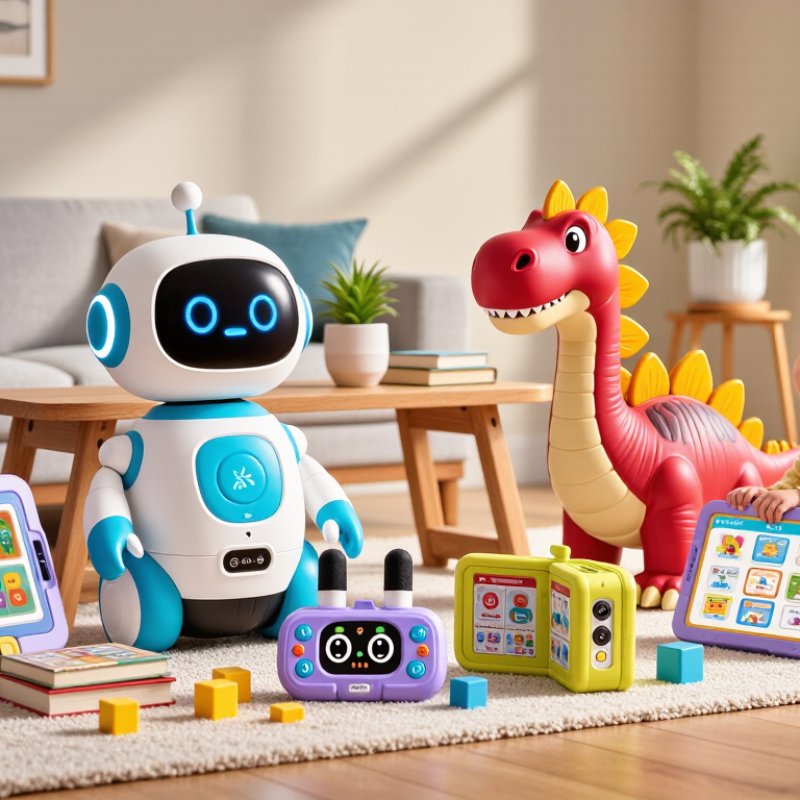
AI toys made in China now cover several distinct categories, not one uniform product. Conversational robots and AI plush toys use speech recognition, microphones, and adaptive dialogue. They can answer questions, tell stories, or remind children about routines. Smart pets add movement, facial reactions, and simple emotional responses. The interaction feels more physical than using a screen.
Learning toys form another major group. Coding robots teach sequencing through buttons, cards, or visual programming. Adaptive learning devices adjust questions after observing a child’s answers. Some combine cameras with augmented reality, placing digital characters over books or play mats. The global smart toys market was valued at about $14.2 billion in 2023, according to Grand View Research. MarketsandMarkets also forecasts strong growth for educational robotics through the decade. These figures suggest wider adoption, but definitions vary between reports.
China’s manufacturing ecosystem supports compact sensors, rechargeable batteries, speech modules, and colorful molded shells at competitive prices. In factory testing, developers should check microphone accuracy, heat control, battery protection, and offline functions. A toy may understand clear adult speech but struggle with a child’s pronunciation. That matters. Privacy design also deserves careful review, especially when toys collect voice data. The category remains uneven. Some products feel clever for ten minutes. Others encourage repeated building, movement, and problem-solving, which is probably the stronger direction.
How Do China’s Best AI Toys Work?
China’s best AI toys combine microphones, sensors, processors, and software in a small body. A child speaks into the toy, and its microphones capture the sound. Speech-recognition software changes those sounds into text. The system then identifies the question and selects a suitable response. Some toys process simple commands locally. More complex conversations may use a secure cloud service. The toy receives the answer and reads it aloud through a small speaker. It feels immediate, but several hidden steps happen within seconds.
Some models also use cameras or motion sensors. A camera may recognize an object, read a picture, or notice basic facial movement. Motion sensors help the toy turn, dance, or react when touched. Language models can create stories, explain words, and adjust replies to a child’s age. Yet they do not truly understand feelings. They predict useful language from patterns. That difference matters.
In hands-on use, response quality depends on room noise, internet stability, and microphone placement. A noisy kitchen can produce strange answers. It is not magic. Parents should check recording controls, data storage, and account permissions before regular use. Offline functions are often more limited, but they can reduce privacy risks. I would also question overly confident answers, especially about health, safety, or serious emotions. These toys can support play and learning, but adult guidance remains necessary. They sometimes sound wiser than they are.
What Features Should Buyers Compare?
When comparing AI toys made in China, buyers should examine more than appearance and price. Start with the toy’s AI purpose. Does it answer questions, tell stories, support learning, or react to touch? Test several prompts, including a child’s unclear question. Watch for delays, repeated answers, or confident mistakes.
Safety features deserve close attention. Check the microphone, camera, data storage, and parental controls. Can adults delete recordings? Can the toy work without constant internet access? Confirm that the product includes safety documents for the intended market, rather than trusting a vague compliance label. A secure charging port, rounded edges, washable surfaces, and a battery that stays cool during play also matter.
Compare language quality in real household conditions. Try background noise, different accents, and simple bilingual commands. AI performance may change after a software update. Ask how often updates arrive and whether support remains available after purchase. Inspect the hinge, speaker openings, buttons, and cable connection; these small parts often reveal weak quality control. Educational content should encourage creative play, not simply produce endless automatic answers. That distinction is easy to miss.
No comparison is perfect. A toy with excellent conversation skills may have poor repair options. Another may feel sturdy but offer shallow learning content. Read independent reviews, request clear warranty terms, and test the return process before trusting impressive demonstrations.
How Can Families Choose and Use Them Safely?
AI toys made in China can offer storytelling, language practice, and responsive games. Their value depends on safe design, not novelty alone. Families should check the recommended age, material information, battery instructions, and customer support before buying. A clear privacy policy matters when a toy uses microphones, cameras, or cloud services. Parents should confirm where recordings are stored and how they can be deleted.
Tips: Test the toy before giving it to a child. Cover the camera when it is unnecessary. Use a separate account and a strong password. Turn off voice recording during sleep or private family conversations. Keep firmware updated, but review new permissions after each update. Charge batteries on a hard surface, away from bedding. Start with short play sessions and watch for confusing or frightening responses.
Children also need simple rules. They should not share their full name, address, school, passwords, or family routines with an AI toy. Adults should explain that the toy can sound confident and still be wrong. This is easy to forget. A weekly check of settings, cables, and online activity can reveal small problems early. No checklist catches every failure, so parents should trust careful observation over advertising claims. If the toy becomes unusually hot, repeats unsafe advice, or behaves strangely, disconnect it and contact the seller or manufacturer.
FAQS
It combines local hardware production, software, language processing, and supply-chain control. Factory scale alone proves little. The toy must respond usefully, protect children, and provide clear privacy controls.
Common types include conversational robots, interactive plush toys, smart pets, coding robots, and adaptive learning devices. Some move or react to touch. Others teach sequencing, storytelling, or basic problem-solving.
Microphones capture a child’s speech and speech-recognition software converts it into text. The system selects a response and plays it through a small speaker. Some commands work offline. Complex replies may need an online service.
Performance depends on pronunciation, background noise, microphone placement, and internet stability. A quiet bedroom may produce better results than a busy kitchen. Children’s speech can still confuse the system.
Not fully. They recognize patterns in words, pauses, or facial movement. Their emotional replies may sound caring without genuine understanding. They can sound wiser than they are.
Check microphone switches, recording storage, account permissions, data deletion, and parental settings. Packaging should explain where recordings are stored. Offline play can reduce some privacy concerns.
Yes, although they are usually more limited. Offline commands may include songs, movements, or simple learning activities. They reduce dependence on an internet connection. Not perfectly.
Ask repeated questions in quiet and noisy rooms. Test pronunciation, battery warmth, response accuracy, and movement. Try unsuitable or confusing questions, too. Failures reveal more than a polished demonstration.
No. They can support play, language practice, movement, and learning. Adults should review answers about health, safety, or serious emotions. The toy may respond confidently and still be wrong.
Conclusion
China-made AI toys combine interactive hardware, software, and intelligent features designed for play, learning, and companionship. They may include voice-enabled robots, educational devices, programmable kits, smart plush toys, and interactive vehicles. These products typically use microphones, sensors, cameras, processors, and AI software to recognize speech, respond to questions, detect movement, adapt activities, or support creative learning. Their quality can vary, so buyers should consider language support, response accuracy, durability, battery life, offline functions, app compatibility, and whether the toy is suitable for the child’s age.
Families should also compare privacy settings, data collection policies, parental controls, material safety, and the reliability of software updates. A good choice should encourage imagination and communication rather than replace real-world interaction. Adults can help children set clear usage limits, explain how the toy works, review permissions, and supervise online or connected features. By balancing educational value, entertainment, safety, and practical performance, families can select AI toys that are engaging, age-appropriate, and easier to use responsibly.