Finding a reliable supplier for AI talking plush toys takes more than reviewing a polished catalog. The product combines a familiar soft toy with microphones, speakers, software, and sometimes cloud-based services. Each part affects quality, privacy, repair needs, and the child’s experience. A sample may sound charming in a showroom, yet respond poorly in a noisy room. Details matter.
Circana reported that toy sales rose 7% across 12 tracked markets during the first half of 2024. That figure describes the broader toy market, not AI talking plush toys specifically. It signals activity, not guaranteed demand for any one product category. Buyers should verify a supplier’s production history, component traceability, quality-control records, and ability to provide consistent samples. Ask to hear the toy at different volumes. Check seams, button placement, charging access, and whether spoken responses remain clear after repeated use.
AI pioneer Andrew Ng has said, “AI is the new electricity.” His remark concerns AI broadly, not plush toys; it is a useful reminder that embedded intelligence depends on dependable systems. For this category, suppliers should explain what the toy can do, how updates work, and what happens when connectivity fails. Ask for specific answers, not promises. A thoughtful supplier welcomes these questions and documents the responses. Even then, no checklist removes every risk. This guide examines practical ways to assess suppliers, test product claims, and choose a partner with evidence behind its pitch.
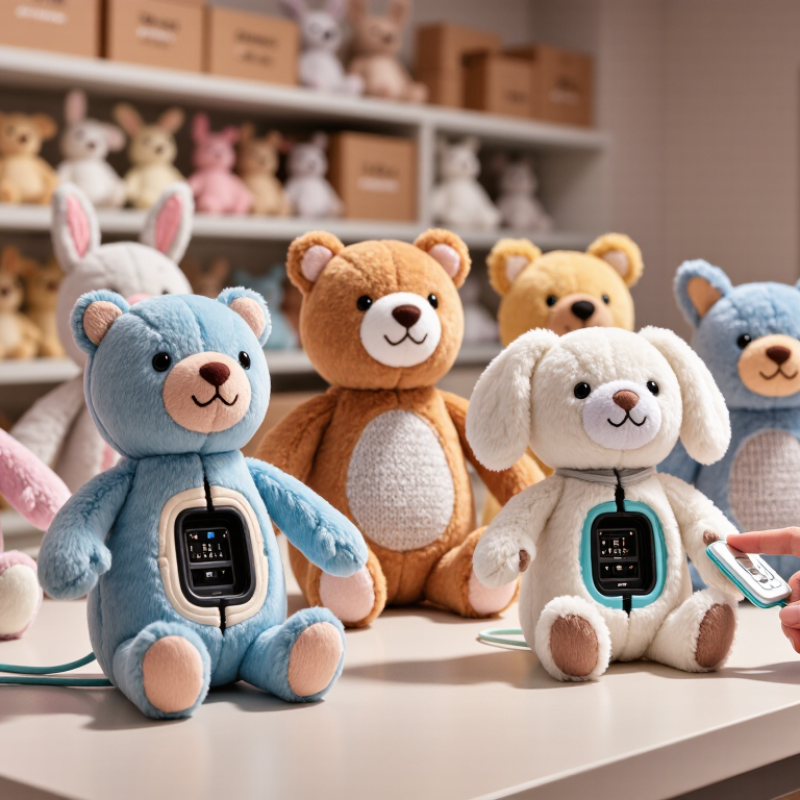
Before contacting suppliers, define what the plush toy should do and who will use it. Is it meant to tell bedtime stories, answer simple questions, or play recorded messages? Choose the main function, not a long list of impressive features. Small details matter. Note the toy’s approximate height, shape, fabric feel, and desired sound level. A soft voice that works in a quiet bedroom may disappear in a busy playroom.
Describe how people will interact with it. Specify supported languages, whether users can record their own messages, and how the toy charges or replaces batteries. If it connects to an app or network, state what that connection needs to accomplish. Avoid vague phrases like “smart AI.” Ask for examples of expected questions and suitable responses. Test them early. I would not assume a plush toy understands every child’s wording; clear limits make evaluation more realistic.
Set practical quality expectations before comparing quotes. Request a sample with the intended fabric, stitching, speaker placement, and electronics—not just a similar display model. Define acceptable sound clarity, button response, wash-care needs, and packaging details. Ask suppliers how they inspect these features and what happens when a sample fails. Leave room for revision, but record each change. Specifications can feel tedious, and some details will still be missed; that is a reason to review a physical sample carefully, not to skip one.
Finding potential suppliers starts with a clear shortlist. Search for manufacturers that openly describe their design, assembly, and quality-control processes. A detailed product page is useful, but it is not proof of capability. Ask for a company profile, factory address, and examples of similar interactive plush toys. Request current photos or a video showing the production area and finished products. Check whether the supplier explains how voice functions, fabric choices, and stitching are tested. Vague answers deserve follow-up. It is easy to overvalue polished catalogs; I would treat them as a starting point, not evidence.
Review backgrounds before discussing a large order. Look for consistent business history, relevant product experience, and verifiable customer references. Contact references with specific questions about sample accuracy, communication, and delivery consistency. During a video call, ask the supplier to show a sample and explain how it is assembled. Notice whether answers are direct or rehearsed. No checklist is perfect, and a small supplier may have limited public information. In that case, request clearer documentation and begin with a manageable sample order. A reliable partner should welcome reasonable questions and describe limitations honestly.
A reliable AI talking plush toy supplier should explain what the toy can actually do, not just show a polished video. Ask for a live demonstration using unfamiliar questions and different voices. Check response time, speech recognition in a noisy room, and what happens when the internet connection drops. Request written specifications for supported languages, software updates, and data handling. A demo is not proof. Ask how performance is tested across repeated sessions.
Safety needs evidence, not reassurance. Request current test reports from qualified laboratories and verify that the reports match the exact toy model and materials you plan to order. Confirm age grading, labeling, battery protection, and small-part controls for the intended market. Inspect seams, embroidery, and removable accessories on a physical sample. Small details matter. A soft ear that begins to loosen after gentle pulling deserves a closer review.
Production quality can shift between samples and bulk orders. Ask for a pre-production sample, a written materials list, and inspection records from recent batches. Compare the sample’s stitching, sound volume, and voice consistency with the approved specification. If possible, arrange an independent factory inspection before shipment. One weakness in supplier checks is relying too heavily on paperwork; it helps, but it cannot replace examining the product. A trustworthy partner should welcome specific questions and explain what still needs improvement.
Verify AI capabilities, safety standards, and production quality before choosing a supplier.
Suggested evaluation framework, not an industry survey: review each area using documented tests, applicable safety and regulatory records, and production samples.
A reliable supplier should send a production-representative sample, not a polished showroom toy. Test it in a quiet room and beside ordinary household noise. Check whether the microphone catches a child’s voice, whether replies feel delayed, and whether the speaker sounds muffled through the plush fabric. Inspect seams, stitching, button placement, and access to charging ports. Try the toy repeatedly; one successful conversation proves little. McKinsey’s 2023 global AI survey found that 55% of respondents used AI in at least one business function. That broad figure does not verify a supplier’s AI claims. Ask for a plain-language explanation of the voice system, its limitations, and how updates are handled.
Communication is part of the sample test. Send the same technical questions to each candidate, then note response time and whether answers include specifics. Request a written sample report, material details, and a clear process for handling failed units. Small warning signs count. A supplier who avoids direct answers before payment may not become more responsive later. McKinsey’s 2020 supply-chain report found that 93% of surveyed leaders planned to increase supply-chain resilience. For a buyer, that makes backup capacity and transparent production updates worth discussing early.
Before ordering, put the details in writing: sample approval criteria, minimum order quantity, production lead time, payment milestones, inspection access, and remedies for defects. Define what “working voice interaction” means, such as successful responses across a set of test phrases. Confirm whether a revised sample requires new approval. A sample can still differ from mass production; I would treat that risk as real, not theoretical. Start with a manageable pilot order when possible, and compare randomly selected units against the approved sample before shipment.
Use this practical scorecard to compare suppliers consistently. Suggested screening benchmarks are starting points, not universal industry standards; confirm product, safety, and commercial requirements for your destination market.
| Evaluation Area | What to Check | Evidence to Request | Reliable Signal | Warning Sign |
|---|---|---|---|---|
| Sample quality | Compare the sample with the approved drawings, materials, dimensions, colors, and stitching details. | A dated sample checklist, product specification, and written record of requested changes. | The supplier identifies any differences between the sample and the intended production version before approval. | Verbal assurances without a revised specification or confirmation. |
| Voice and audio | Test speech clarity, volume control, playback consistency, and performance in a quiet room and a typical indoor setting. | A functional demonstration and details of the speaker, audio files, controls, and supported languages. | Speech is intelligible at the intended listening distance, and playback behavior matches the written specification. | Audio quality varies noticeably between tests or key features are described only as “AI” without explanation. |
| AI features and connectivity | Clarify whether responses run on-device or require an internet connection, account, app, or paid service. | A feature list covering connectivity, supported devices, data handling, service dependencies, and update method. | Offline and online functions are clearly distinguished, with known limitations disclosed in writing. | Claims of unrestricted or always-available AI without explaining network or service requirements. |
| Battery and charging | Check battery type, capacity, charging method, approximate runtime, and whether the battery is replaceable. | Written battery specifications, charging instructions, and applicable test or compliance documentation. | Runtime claims state the test conditions, and the charging arrangement is suitable for the target market. | Unspecified battery details, incompatible charging accessories, or unsupported runtime claims. |
| Child safety and materials | Review age grading, small parts, seams, accessible components, and materials relevant to the intended market. | A bill of materials, age-grade rationale, and test reports applicable to the destination market and product configuration. | Documents match the actual materials, model, and age grade; the supplier explains any testing limits. | Generic certificates that cannot be linked to the product or configuration being ordered. |
| Sample revisions | Confirm how many revision rounds are included, the cost of additional samples, and whether the final sample is retained as a reference. | A written sample plan listing revision scope, charges, lead times, and approval method. | The approved reference sample is identified and used as the production comparison standard. | Unclear sample charges or no agreed process for approving the final version. |
| Communication | Assess response clarity, technical knowledge, and follow-through on questions about features, testing, and production. | A written question-and-answer record with named roles for sales, engineering, and quality matters. | Answers address the specific question, identify open items, and provide realistic next steps. | Repeatedly changing answers, missed details, or pressure to place an order before specifications are clear. |
| Production capacity | Ask about production location, relevant experience, available capacity, and subcontracted processes. | A process overview, production schedule, and disclosure of any outsourced assembly or testing. | Capacity and lead-time estimates are tied to the product specification and order quantity. | Guaranteed deadlines without checking materials, customization, or production load. |
| MOQ and pricing | Confirm minimum order quantity (MOQ), unit-price breaks, sample charges, setup costs, and packaging costs. | A dated quotation showing currency, quantity tiers, included items, exclusions, and validity period. | Prices are itemized, and any tooling, customization, or packaging charges are disclosed. | A headline price that excludes important costs or has no stated scope. |
| Order and payment terms | Review deposit and balance timing, accepted payment methods, cancellation terms, and remedies for non-conforming goods. | A purchase agreement or pro forma invoice that matches the approved specification and quotation. | Payment milestones, inspection rights, and responsibilities are explicit before funds are sent. | Requests to pay an unrelated party or material terms that differ from the written quotation. |
| Quality control | Agree on inspection timing, product checks, defect handling, and approval before shipment. | A written inspection plan covering function, appearance, packaging, and agreed acceptance criteria. | Inspection results are documented, and the process explains how failed checks are corrected. | No inspection access or no defined process for addressing defects. |
| Shipping and packaging | Confirm packed dimensions, carton quantity, shipping method, delivery terms, and responsibility for freight and import charges. | A packing specification and quotation stating the agreed delivery term and shipment details. | Shipping assumptions and cost responsibilities are clear before the order is confirmed. | Delivery estimates that omit production time, customs clearance, or shipping responsibilities. |
Decision rule: Approve a supplier only after the final sample, product specification, applicable compliance documents, quotation, and order terms are consistent with one another. Keep written records of approvals and agreed changes.
Reliable sourcing starts with evidence you can compare, not polished promises. Ask each supplier for the same proof: a working sample, a component list, and a written quality-control process. Listen to the sample in a quiet room. Check whether speech is clear, volume stays steady, and the toy responds consistently.
Compare records, not just prices. Request material specifications, incoming-inspection checks, production photos, and defect-handling examples from a recent batch. A capable supplier should explain who tests each unit, what gets recorded, and how failed units are corrected. Ask for a small pilot run before discussing larger quantities. Small details matter.
Keep the evidence side by side in a simple scorecard: sample performance, documentation, communication, lead-time assumptions, and after-sales support. Verify references where possible, and make sure quoted capabilities appear in the written agreement. A quick, precise answer is useful; a vague answer is a warning. Still, no folder proves everything. A neat inspection sheet can miss a weak speaker wire or uneven stitching. Ask follow-up questions, inspect samples yourself, and note what remains uncertain before choosing a partner.
Choose one main function, such as bedtime stories or recorded messages. Describe the toy’s size, fabric, sound level, languages, and charging method. “Smart AI” is too vague.
Test the sample in a quiet room and near normal household noise. Try several childlike questions. Check microphone pickup, reply delays, and sound through the plush fabric. Test it again.
Ask for the intended fabric, stitching, speaker placement, buttons, and electronics. A display model may look convincing but reveal little about production quality.
Set expectations for clear sound, responsive buttons, seams, care instructions, and packaging. Ask how failed samples are handled. Keep a record of every revision.
Request a plain-language explanation of its limits and updates. Ask whether it handles specific test phrases reliably. Do not assume it understands every child’s wording.
Send each supplier the same technical questions. Note response time and whether answers include details. Evasive replies before payment deserve attention.
Confirm the minimum order, lead time, payment stages, inspection access, and remedies for defects. Define successful voice interaction with a set of test phrases. Require approval for revised samples.
Start with a manageable pilot run when possible. Compare randomly selected units with the approved sample before shipment. Some differences may still slip through.
Request a working sample, component list, material details, inspection records, and defect-handling examples. Use a simple scorecard. Paperwork helps, but it can miss a weak speaker wire or uneven stitching.
Finding reliable AI talking plush toys suppliers starts with defining your product requirements, including the toy’s intended users, design, interactive features, materials, and expected order volume. Use these criteria to identify potential suppliers, then review their experience, manufacturing capabilities, and track record. A supplier’s claims should be supported by clear information rather than promises alone.
Before making a decision, assess how the AI features work, ask for evidence of applicable safety standards and quality-control procedures, and evaluate product samples for comfort, durability, and performance. Pay attention to response times, clarity, and willingness to discuss customization. Finally, compare suppliers using consistent evidence, including sample quality, production capacity, communication, pricing, lead times, and order terms. Selecting a partner through this careful process can help reduce uncertainty and build a more dependable supplier relationship.