Sourcing AI smart plush toys wholesale requires more than comparing factory quotations. Buyers must assess product safety, child-appropriate design, software reliability, and supplier transparency. The U.S. toy industry generated approximately $28.6 billion in 2023, despite an 8% sales decline, according to Circana’s 2023 toy industry data. This pressure makes cost control important, but low prices can conceal weak testing or unstable components.
Demand for connected play is still developing. Fortune Business Insights estimated the global smart toys market at about $14.13 billion in 2023 and projected continued growth through 2032. However, market estimates differ because companies define “smart toys” differently. That uncertainty deserves attention. Buyers should request clear product specifications, sample units, firmware details, battery information, and documented quality procedures before negotiating volume orders.
A reliable sourcing process also examines regulatory readiness. Plush toys intended for the United States may require compliance with CPSIA and ASTM F963 requirements. European products may need to meet EN 71 and applicable data-protection obligations. Connected toys with microphones, applications, or cloud services need stronger privacy controls. The FTC’s guidance on children’s privacy highlights the importance of responsible data practices. Check every claim.
In practical wholesale evaluation, compare five details: material safety, voice-response accuracy, washable construction, software support, and after-sales service. Ask how suppliers manage recalled batches and replacement parts. A factory video is useful, but independent test reports are stronger evidence. The best supplier is not always the cheapest. It is the partner that can explain risks clearly, provide traceable documentation, and improve the product when early samples reveal problems.
Define AI Smart Plush Toys by Interaction, Connectivity, and AI Functions
How to Source AI Smart Plush Toys Wholesale?
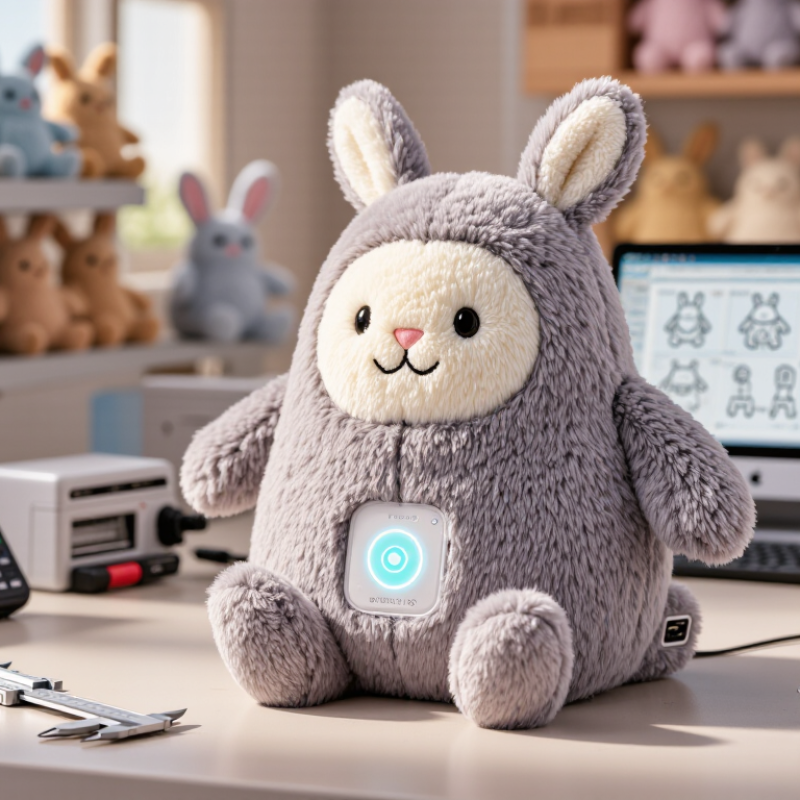
AI smart plush toys should be defined through interaction, connectivity, and AI functions. Interaction may include voice replies, touch sensors, movement, storytelling, or emotional feedback. A toy that only plays recorded sounds is interactive, but not necessarily AI-enabled. That distinction matters.
Grand View Research estimates the global smart toys market will expand strongly through 2030, driven by connected play and intelligent features. Its market analysis also highlights voice interaction and internet connectivity as important growth factors. For wholesale sourcing, request a live demonstration, not only a product video. Check response time, speech accuracy, sensor sensitivity, and performance in a noisy room. A voice demo can still mislead.
Connectivity creates additional buying questions. Ask whether the toy works offline, requires an application, or depends on cloud processing. Confirm software update methods, account requirements, data storage, and parental controls. UNICEF’s Policy Guidance on AI for Children stresses privacy, safety, transparency, and child-centered design. These points deserve practical testing. Try deleting a user profile. Inspect the microphone switch. Test the toy after Wi-Fi is removed. Some suppliers may provide impressive AI claims but weak documentation. I would not trust unclear answers about data handling. Review battery reports, material tests, charging protection, and applicable toy safety documents before placing a wholesale order.
How to Source AI Smart Plush Toys Wholesale? - Define AI Smart Plush Toys by Interaction, Connectivity, and AI Functions
| Evaluation Dimension | Entry-Level Interactive Plush | Connected AI Smart Plush | Advanced Conversational Plush | Wholesale Sourcing Checkpoints |
|---|---|---|---|---|
| Core Product Definition | Soft toy with preset electronic responses and limited local interaction. | Plush toy with sensors, mobile connectivity, cloud-supported functions, and configurable content. | Plush toy with natural-language conversation, adaptive responses, and multiple connected services. | Confirm whether the product is genuinely AI-enabled or only uses pre-recorded audio and fixed scripts. |
| Primary Interaction Methods | Press sensors Voice trigger Motion response | Touch sensors Voice input Mobile app | Natural speech Touch Gesture or motion App control | Request an interaction map showing each sensor, trigger condition, response type, and recovery behavior. |
| Typical Interaction Output | Preset sounds, songs, phrases, vibration, light effects, or simple movement. | Generated or selected voice responses, personalized routines, notifications, and interactive games. | Context-aware dialogue, follow-up questions, storytelling, educational activities, and personalized conversation. | Ask for a live demonstration using unprepared questions rather than a scripted presentation. |
| Connectivity | Usually offline; may use a short-range wireless connection for setup or audio. | Commonly uses Bluetooth Low Energy for setup and Wi-Fi or a paired phone for online functions. | Usually requires Wi-Fi or a smartphone gateway for cloud-based speech and AI processing. | Verify supported wireless bands, pairing limits, connection recovery, and operation when the internet is unavailable. |
| Offline Capability | Basic interaction normally remains available without internet access. | Preset commands may work offline; cloud-based functions generally do not. | Advanced conversation, remote content updates, and account-linked features generally require internet access. | Define which functions must remain available during network outages and document them in the product specification. |
| AI Function Level | Usually no generative AI; uses programmed rules or recorded content. | May include speech recognition, recommendation logic, content personalization, or limited conversational AI. | May include speech-to-text, natural-language processing, text-to-speech, contextual memory, and content moderation. | Ask whether AI processing occurs on-device, in the cloud, or through a third-party service, and identify recurring service dependencies. |
| Language Support | Fixed phrases in selected languages; language changes may require a firmware or audio package. | App menus and voice functions may support different language sets. | Language quality depends on the speech-recognition and text-to-speech systems used by the supplier. | Test pronunciation, accent handling, child speech recognition, response speed, and language switching before approval. |
| Data and Privacy Controls | Limited data collection if the product works fully offline. | May collect account, device, usage, voice, or diagnostic data when connected. | May process voice recordings, conversation history, child profile data, and parental-control settings. | Require a data-flow description, privacy policy, deletion procedure, parental controls, encryption details, and retention period. |
| Microphone and Audio Hardware | One microphone or sound sensor with a small speaker is common. | May use one or more microphones, a speaker, echo reduction, and software-based wake-word detection. | Typically needs improved microphone placement, noise reduction, speaker clarity, and speech feedback controls. | Check microphone sensitivity, audible recording indicators, volume limits, sound distortion, and child-safe acoustic performance. |
| Power System | Replaceable batteries or a small rechargeable battery are common. | Rechargeable lithium-ion or lithium-polymer batteries are commonly used for wireless functions. | Usually requires a larger battery or more frequent charging because microphones, speakers, wireless radios, and processors consume more power. | Confirm battery capacity, charging time, operating time, cycle performance, protection circuit, and battery replacement policy. |
| Charging Interface | May use a battery compartment or a basic charging connector. | Commonly uses a USB charging cable or a concealed charging port. | Usually requires a secure charging design, charging-status indicator, and protection against overcharge and overheating. | Inspect connector durability, cable specifications, charging instructions, and accessibility of the charging port to children. |
| Safety and Compliance Areas | Mechanical, flammability, material, small-parts, and battery safety requirements apply. | In addition to toy safety, wireless, electromagnetic compatibility, battery transport, and chemical requirements may apply. | Also requires privacy, cybersecurity, software-update, audio, and connected-product risk controls. | Request applicable test reports for the target market, including toy safety, wireless, EMC, RoHS or equivalent chemical controls, and lithium-battery transport documentation where relevant. |
| Recommended Age Positioning | Often positioned by physical design, small-part risk, and interaction complexity. | Age positioning should consider app access, account creation, internet use, and voice-data processing. | Age positioning should include conversational content, supervision requirements, privacy risks, and parental controls. | Do not rely only on a printed age label; review foreseeable use, misuse, supervision, and digital-content risks. |
| Firmware and Content Updates | Updates may require a physical connection or may not be supported. | Updates may be delivered through a mobile application or connected device. | Cloud services, language models, safety filters, and content libraries may be updated remotely. | Clarify update frequency, update duration, rollback process, end-of-support policy, and whether updates can disable core functions. |
| Customization Options | Fabric, color, embroidery, packaging, sound files, and basic electronics may be customizable. | May support customized app interface, voice prompts, content packs, packaging, and selected hardware features. | May require customized wake words, character personality, content rules, language models, and cloud-service configuration. | Separate one-time engineering charges from per-unit costs and confirm ownership of artwork, audio, software, and training data. |
| Typical Development Complexity | Low to medium; focuses on plush construction, electronics integration, and scripted interaction. | Medium to high; requires hardware, firmware, app, connectivity, and backend coordination. | High; requires reliable speech processing, cloud infrastructure, privacy controls, moderation, testing, and ongoing maintenance. | Evaluate the supplier’s software support capability, not only its sewing and assembly capacity. |
| Indicative Wholesale MOQ | Often lower when the design uses existing molds, fabrics, and electronic modules. | Usually higher because app, firmware, connectivity, and certification costs are distributed across the order. | Often requires a larger commercial commitment or a recurring service agreement because of cloud and software costs. | Request separate MOQ figures for stock models, logo customization, structural changes, private-label software, and new AI features. |
| Lead-Time Drivers | Fabric sourcing, sampling, electronics assembly, and safety testing. | Hardware production, app configuration, firmware testing, wireless approval, and packaging. | Conversation testing, content moderation, backend integration, privacy review, pilot production, and field testing. | Obtain a milestone schedule covering sample approval, software freeze, compliance testing, mass production, and final inspection. |
| Quality-Control Priorities | Seam strength, stuffing consistency, loose parts, sound output, switch function, and battery compartment security. | All physical checks plus pairing success, app stability, sensor accuracy, charging, wireless range, and firmware installation. | All connected-product checks plus response latency, transcription accuracy, refusal behavior, privacy controls, crash recovery, and service availability. | Use a written inspection checklist with functional tests performed on a statistically valid production sample. |
| Best-Fit Wholesale Use Case | Promotional gifts, seasonal toys, simple character products, and low-complexity retail programs. | Educational products, connected character toys, subscription-linked content, and app-supported retail products. | Premium educational, companion, therapeutic-support, or personalized character products requiring continuing software support. | Match the product class to your budget, target age, privacy obligations, support capability, and expected product life cycle. |
FAQS
It should respond through voice, touch, movement, stories, or emotional feedback. Recorded sounds alone do not prove AI capability. Request a live demonstration.
Test response speed, speech accuracy, and microphone sensitivity. Speak near background noise, then repeat from different distances. Voice demos can still mislead.
Ask whether it works offline, needs an application, or depends on cloud processing. Remove Wi-Fi during testing. Check which functions stop working.
Ask where voice recordings are processed and whether they are stored. Request deletion steps, access controls, and security documents. Unclear answers deserve caution.
Test voice recognition, speaker clarity, battery life, stitching, and washable parts. Check the charging protection and material reports. A sample can reveal production weaknesses.
Request written dates for materials, programming, assembly, inspection, and shipping. A late sample may indicate scheduling problems. Do not rely on one optimistic promise.
Include packaging, testing, freight, insurance, duties, storage, and possible rework. Compare quotations under identical delivery terms. Unit price is only one part.
Do not approve bulk production without testing a working sample. I once focused too heavily on factory price. That was a mistake. Leave room for delays and software work.
Conclusion
Sourcing AI smart plush toys wholesale starts with defining the product clearly. Evaluate whether the toy offers interactive features such as voice responses, touch sensing, learning functions, app connectivity, or adaptive AI behavior. Use Circana’s reported global toy sales of $108.7 billion in 2023 as a broad market reference, then estimate demand by segmenting buyers according to age group, retail price, intended use, and regional requirements. Products designed for children, educational settings, gifting, or adult collectors may require different specifications, packaging, and communication strategies.
Before placing an order, audit each supplier’s quality systems and documentation. Confirm testing and compliance with relevant standards, including ASTM F963-23, EN71, CPSIA, and COPPA where applicable. Compare minimum order quantities, sample fees, production lead times, customization options, data-security practices, warranty terms, and total landed costs. A reliable supplier should provide transparent technical files, traceable materials, clear privacy safeguards, and consistent pre-shipment inspections. This structured process helps buyers select safe, compliant, and commercially suitable products while reducing quality, regulatory, and supply-chain risks.