Schools are moving beyond screens and textbooks. AI Educational Machines now include classroom robots, adaptive tutors, coding kits, speech assistants, and intelligent laboratory tools. These systems can observe learning patterns, offer immediate feedback, and make difficult ideas more tangible. A small robot tracing angles on a classroom floor may explain geometry better than a static diagram.
Dr. Rose Luckin, a leading artificial intelligence and education researcher, has said, “AI will not replace teachers, but teachers who use AI will replace those who don’t.” Her warning deserves careful interpretation. Technology should support professional judgment, not weaken it. A teacher still understands a child’s confidence, frustration, and sudden silence. A machine usually does not.
This guide examines the top 10 AI Educational Machines for schools. The comparison considers instructional value, age suitability, reliability, accessibility, data protection, maintenance, and total classroom cost. It also asks practical questions. Can teachers control the system? Does it work with limited internet access? Can students explain its feedback? Are its recommendations understandable?
No ranking is flawless. Some machines perform impressively in demonstrations but struggle during crowded lessons. Others look simple yet produce stronger learning because teachers can use them quickly. That difference matters. Schools need evidence from real classrooms, not polished advertisements. The best choice may not be the newest machine. It may be the one that serves a clear learning goal, respects student privacy, and remains useful after the first wave of excitement fades.
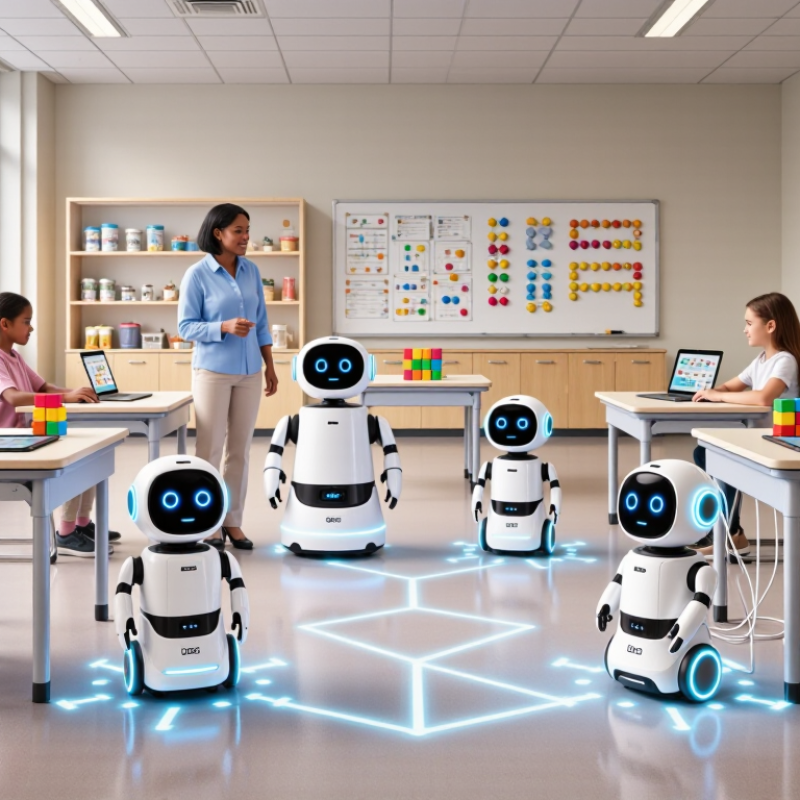
An AI educational machine is more than a screen with a chatbot. In school settings, it is a physical device or software system that senses learning activity, processes information, and adjusts support. It may be an adaptive tutor, language-practice robot, coding platform, laboratory sensor, accessibility tool, or simulation station. A fixed projector does not qualify. A tutoring system that changes question difficulty after repeated errors might qualify. The boundary remains messy.
UNESCO’s 2023 Guidance for Generative AI in Education and Research reported that fewer than 10% of surveyed schools and universities had formal guidance for generative AI. That finding exposes a practical weakness: many schools consider tools before defining responsible use. OECD PISA 2022 also found that about 30% of students were distracted by digital devices in most mathematics lessons. Therefore, a useful machine needs teacher controls, clear feedback, strong privacy safeguards, and an offline fallback. Fancy automation is not enough.
For a credible top-ten list, schools should assess ten functions: adaptive tutoring, speech practice, reading support, coding instruction, robotics, science sensing, virtual experiments, assessment assistance, accessibility support, and learning analytics. Each tool should show what data it collects and why. A dashboard can misread silence as confusion. Teachers must be able to challenge its recommendations. The World Economic Forum’s Future of Jobs Report 2025 says 86% of employers expect AI and information-processing technologies to transform their organizations by 2030. Schools should prepare learners for that change, but the definition must remain human-centered.
Ranking the top 10 AI educational machines requires more than counting features. Classroom usefulness matters most. During a pilot, teachers should observe whether a machine supports reading, coding, science, or language practice without distracting students. A useful device responds clearly, adapts to different learning levels, and gives explanations rather than unexplained answers. Its feedback should help a teacher identify a child struggling with fractions at 9:20 a.m.
Safety and reliability deserve equal weight. Schools should examine data protection, permission controls, offline functions, and age-appropriate responses. The machine must avoid collecting unnecessary student information. Independent testing, transparent documentation, and regular software updates strengthen its authority. Teachers also need physical safeguards, stable connections, and simple controls. A device that needs constant technical repair cannot serve a busy classroom well.
The ranking should include accessibility, affordability, durability, and measurable learning progress. A strong machine supports speech, text, visual prompts, and varied motor abilities. It should work with existing lessons, not force teachers to rebuild every worksheet. Cost includes training, repairs, subscriptions, and replacement parts. Short trials can reveal useful evidence, but they may hide long-term problems. I would record teacher workload, student engagement, error rates, and assessment results across several weeks. No ranking is perfect. A machine praised in one school may fail in a crowded room with weak internet. That limitation deserves honest attention.
Schools need more than one intelligent device. Each machine should serve a clear learning function.
An adaptive tutor adjusts questions after every response.
A reading coach marks fluency, pauses, and difficult words.
A writing assistant highlights unclear structure.
A language partner models pronunciation and everyday dialogue.
A mathematics engine turns equations into visible steps.
A science simulator lets students test pressure, motion, or ecosystems safely. A coding mentor checks logic without writing every answer. A visual learning device converts diagrams into spoken explanations. A memory trainer schedules revision when recall begins to weaken. A classroom analytics machine shows teachers which concepts need support. These ten functions cover practice, creativity, communication, and assessment.
In real classrooms, usefulness depends on careful supervision.
Teachers should review machine feedback before changing a student’s learning plan. A device may confuse slow reading with weak understanding. It may also reward short answers too generously. No machine reads every child correctly. That matters.
Reliable schools protect student data and explain how recommendations are produced. I would test each device with multilingual learners, students with disabilities, and different age groups. A quiet screen is not proof of learning. Hands-on discussion still reveals mistakes that software can miss. The best machines support professional judgment rather than replace it.
What Are the Top 10 AI Educational Machines for Schools?
In active classrooms, ten machine types show practical value: adaptive tutoring stations, reading companions, coding robots, language practice devices, AI science microscopes, handwriting analyzers, mathematical manipulatives, translation tools, accessibility readers, and classroom response systems. Each supports a different learning moment. A tutoring station can adjust fraction problems after repeated mistakes. A reading companion can pause when a child misreads a sentence. Coding robots make abstract logic visible through movement. Small details matter. A student sees the wheel turn.
Teachers gain faster feedback, not a replacement for professional judgment. Science microscopes can identify cell patterns during laboratory work. Handwriting analyzers may reveal spacing or letter-formation difficulties. Accessibility readers can convert printed instructions into speech for learners with visual or reading challenges. Language devices offer pronunciation practice without public embarrassment. These tools also record progress, helping teachers plan small-group instruction. In my experience, the strongest results appear when machines support a clear lesson objective.
Limitations remain significant. Adaptive systems can misunderstand quiet students, multilingual answers, or creative solutions. Translation tools sometimes miss cultural meaning. Sensors need calibration, cleaning, and reliable internet. Costs include training, repairs, accessibility checks, and secure data handling. A machine may reward quick answers instead of deep thinking. That is a real risk. Teachers should compare machine feedback with conversation, notebooks, and observed behavior. Schools also need transparent evaluation, since impressive demonstrations can hide weak long-term learning. Some devices simply create noise. Reflection is necessary.
Classroom applications, benefits, and limitations
The score is a transparent 0–5 classroom-readiness rating based on instructional usefulness, teacher control, accessibility, safety, and implementation practicality. It compares machine categories rather than companies or brands.
These systems can support adaptive practice, coding, language learning, immersive simulations, laboratory work, collaborative robotics, remote participation, and automated formative assessment.
Potential benefits include personalized feedback, hands-on learning, improved accessibility, rapid progress monitoring, stronger engagement, and opportunities to develop computational and problem-solving skills.
Schools must address privacy, algorithmic bias, unequal access, teacher training, cybersecurity, maintenance, accessibility requirements, student safety, and the risk of replacing meaningful human interaction.
Choosing among the top ten AI educational machines requires more than impressive demonstrations. A classroom robot, adaptive tutor, translation device, or coding assistant must support a clear learning goal. Teachers should observe a live trial with real students, not only review promotional claims. Ask whether the machine improves reading fluency, problem solving, or classroom participation. If its purpose sounds vague, pause.
Safety begins with data. Schools should check microphones, cameras, location tools, and stored student records. Access must use strong passwords and limited staff permissions. Children need simple explanations about what the machine records. They also need a visible way to stop interaction. Never assume automatic answers are correct. A teacher should review sensitive feedback, cultural content, and accessibility features. Bias can hide behind a friendly voice.
Cost includes more than the purchase price. Calculate licenses, staff training, repairs, updates, storage, and replacement parts. A low-cost device may become expensive after one year. Request an itemized quote and a clear support agreement. Test the machine with small groups, including students with disabilities and different language backgrounds. Measure teacher workload after four weeks. Did preparation become easier, or did staff spend evenings correcting errors? A pilot may fail. That failure still provides useful evidence. Schools should record incidents, invite parent questions, and set a review date before expanding use. The strongest choice is not the most advanced machine. It is the one teachers can supervise, students can understand, and the school can afford responsibly.
They support tutoring, reading, writing, languages, mathematics, science, coding, memory, accessibility, and assessment. Each device should serve a clear lesson purpose. One tool cannot teach everything.
They change questions after each response. For example, repeated fraction errors can trigger simpler practice. Teachers should still review the recommendations. The machine may misread hesitation.
They track pauses, fluency, and difficult words. A device might notice a child misreading a sentence. It can provide speech support or extra practice. Quiet reading is not proof of understanding.
Coding robots make abstract logic visible through movement. A student writes instructions, then watches a wheel turn. Errors become easier to discuss. Sometimes the robot distracts from the concept.
They offer pronunciation and everyday dialogue practice. Students can repeat words without speaking before the whole class. This may reduce embarrassment. Cultural meaning can still be missed.
Science simulators and intelligent microscopes support safe experiments. Students can explore pressure, motion, ecosystems, or cell patterns. Sensors require cleaning and calibration. Technology does not replace real observation.
Accessibility readers can convert printed instructions into speech. Handwriting analyzers may identify spacing or letter-formation difficulties. Translation tools can assist multilingual learners. Their interpretation may be incomplete.
Schools must plan for training, repairs, secure data handling, and reliable internet. Systems may reward fast answers instead of deep thinking. Teachers should compare machine feedback with notebooks and conversations. I would test devices with different ages, languages, and abilities before trusting them. That takes time.
AI Educational Machines are intelligent learning tools designed to support teaching, practice, assessment, and student engagement in school settings. This article first defines their role, distinguishing them from ordinary digital devices by emphasizing adaptive learning, interactive feedback, data-informed support, and limited physical or virtual autonomy. It then establishes ranking criteria such as educational value, age appropriateness, accessibility, reliability, ease of classroom integration, privacy protection, affordability, and the quality of teacher controls.
The top ten machines are organized by learning function, including tutoring, language development, coding, science exploration, creative learning, collaboration, accessibility support, and classroom management. The discussion explains how these tools can personalize instruction, encourage curiosity, and reduce repetitive workloads while recognizing limitations such as technical errors, unequal access, distraction, and reduced human interaction. Finally, the article addresses safety, ethical data use, transparency, maintenance costs, and responsible adoption. Schools are encouraged to choose systems that complement teachers, protect students, align with learning goals, and undergo continuous evaluation.